Closed Rhinoplasty Cost in Korea
Introduction
Closed rhinoplasty is a popular nose surgery technique in South Korea, especially among patients seeking natural-looking results with minimal scarring. Because all incisions are made inside the nostrils, there are no visible external scars, making it appealing to both Korean and international patients.
This guide explains closed rhinoplasty cost in Korea, what affects pricing, and whether this approach is right for you.
What Is Closed Rhinoplasty?
Closed rhinoplasty (also called endonasal rhinoplasty) is a surgical technique where all incisions are made inside the nose. Unlike open rhinoplasty, there is no incision on the columella (the strip of skin between the nostrils).
In Korea, closed rhinoplasty is commonly used for:
- Bridge augmentation
- Minor to moderate tip refinement
- Subtle reshaping for a natural profile
It requires a high level of surgical skill, as the surgeon works with limited visibility.
Average Closed Rhinoplasty Cost in Korea
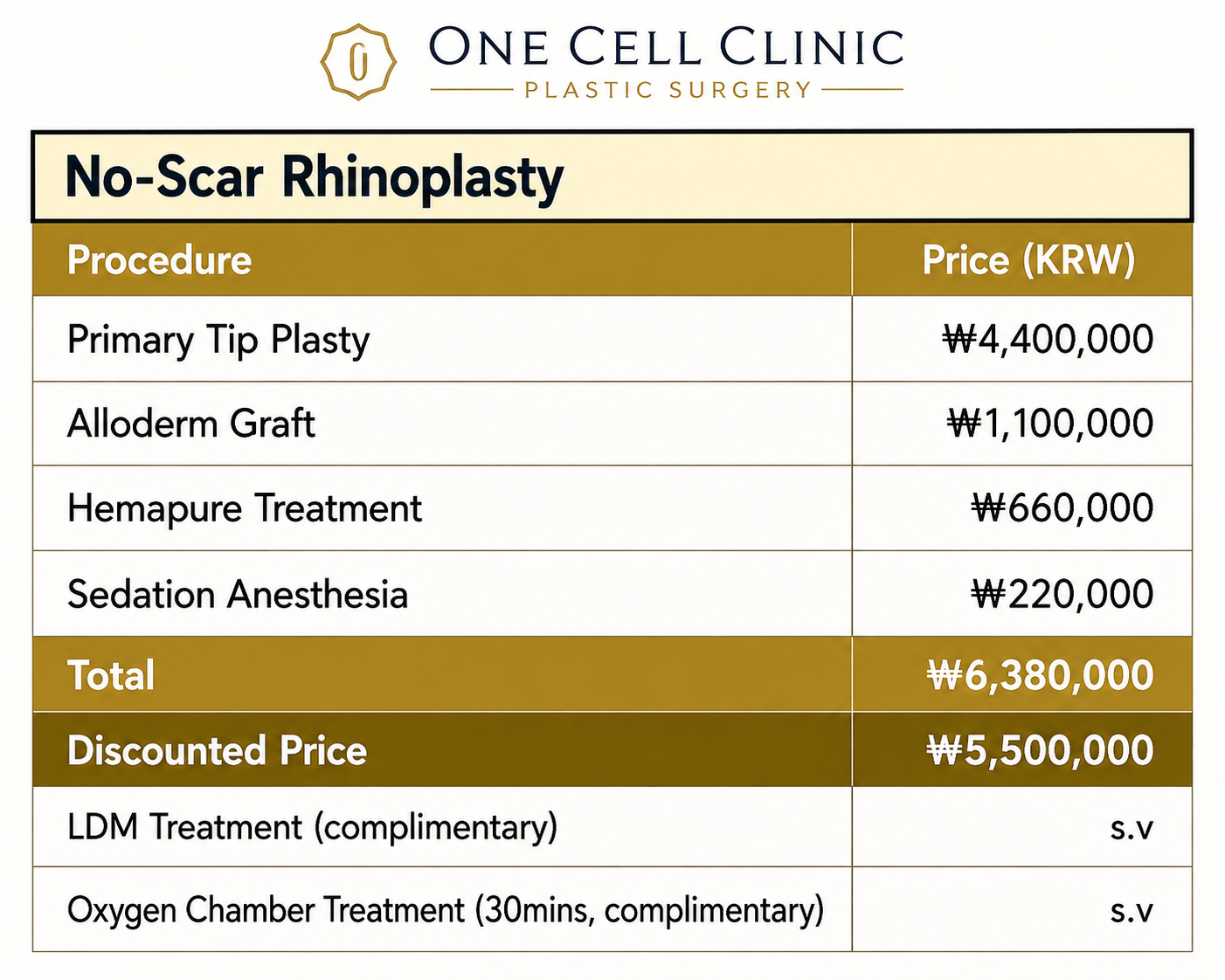
Closed rhinoplasty in Korea typically costs between:
KRW 3,000,000 – 7,000,000
The final price depends on the complexity of the procedure and the materials used. Simple cases are usually at the lower end of the range, while cartilage-based or more refined designs increase the cost.
Closed Rhinoplasty Cost by Case Type
Simple Closed Rhinoplasty
For patients needing minor bridge enhancement or subtle reshaping.
Estimated cost range:
• KRW 3,000,000 – 4,500,000
Usually involves:
- Silicone or basic implant
- Minimal cartilage work
Closed Rhinoplasty with Tip Refinement
For patients who need more definition or projection at the tip.
Estimated cost range:
• KRW 4,500,000 – 6,000,000
May include:
- Septal or ear cartilage
- Tip support techniques
Closed Rhinoplasty Using Autologous Cartilage
For patients preferring natural materials or long-term stability.
Estimated cost range:
• KRW 5,500,000 – 8,000,000+
Common cartilage sources:
- Septal cartilage
- Ear cartilage
What Affects the Cost of Closed Rhinoplasty?
1. Nose Type and Surgical Difficulty
Flat noses, short noses, or thick skin require more advanced techniques and raise the cost.
2. Materials Used
- Silicone implants are more affordable
- Autologous cartilage increases cost
- Rib cartilage is rarely used for closed rhinoplasty but significantly increases price if needed
3. Surgeon Expertise
Closed rhinoplasty requires precision and experience. Highly specialized surgeons usually charge more.
4. Clinic Location
Clinics in Gangnam and Apgujeong often have higher pricing due to specialization and demand.
5. Included Services
Some clinics bundle:
- CT scans
- Anesthesia
- Post-op medication
- Follow-up visits
Others itemize these separately.
Closed vs Open Rhinoplasty: Cost Perspective
Closed rhinoplasty is often slightly less expensive than open rhinoplasty because:
- Surgery time is usually shorter
- Tissue dissection is more limited
However, for complex or revision cases, open rhinoplasty may be recommended regardless of cost.
Recovery and Downtime
Recovery from closed rhinoplasty is generally faster than open rhinoplasty.
Typical timeline:
- Swelling and bruising: 7–10 days
- Stitches removal: usually not needed externally
- Return to daily activities: about 7 days
- Final nose shape: visible over 3–6 months
Many international patients stay in Korea for 7–10 days after surgery.
Who Is a Good Candidate for Closed Rhinoplasty?
Closed rhinoplasty is best for patients who:
- Want subtle, natural changes
- Do not require major structural reconstruction
- Are undergoing primary (first-time) rhinoplasty
- Prefer no external scar
Patients with severe deformities or revision cases may need open rhinoplasty instead.
Why Choose Korea for Closed Rhinoplasty?
Korea is globally known for:
- Surgeons with extensive rhinoplasty specialization
- Natural aesthetic standards
- Competitive pricing compared to Western countries
- High surgical volume and refined techniques
These factors make Korea a top destination for closed rhinoplasty.
Safety and Considerations
Closed rhinoplasty is safe when performed by a qualified specialist. To reduce risk:
- Avoid unusually low prices
- Review real before-and-after cases
- Confirm surgeon experience specifically with closed techniques
- Ask about revision policies
Final Thoughts
Closed rhinoplasty in Korea offers a balance of natural results, minimal scarring, and competitive cost. While not suitable for every nose type, it is an excellent option for patients seeking refined enhancement without visible incisions.
Understanding the cost structure and choosing an experienced surgeon are the most important steps toward a successful outcome.