Closed Rhinoplasty vs Open Rhinoplasty: What’s the Difference?
Introduction
When planning nose surgery in Korea, one of the most important decisions is surgical approach: closed rhinoplasty or open rhinoplasty. Both techniques can produce excellent results, but they differ significantly in incisions, visibility, recovery, and suitability.
Understanding these differences helps patients choose the method that best matches their nose structure, goals, and expectations.
What Is Closed Rhinoplasty?
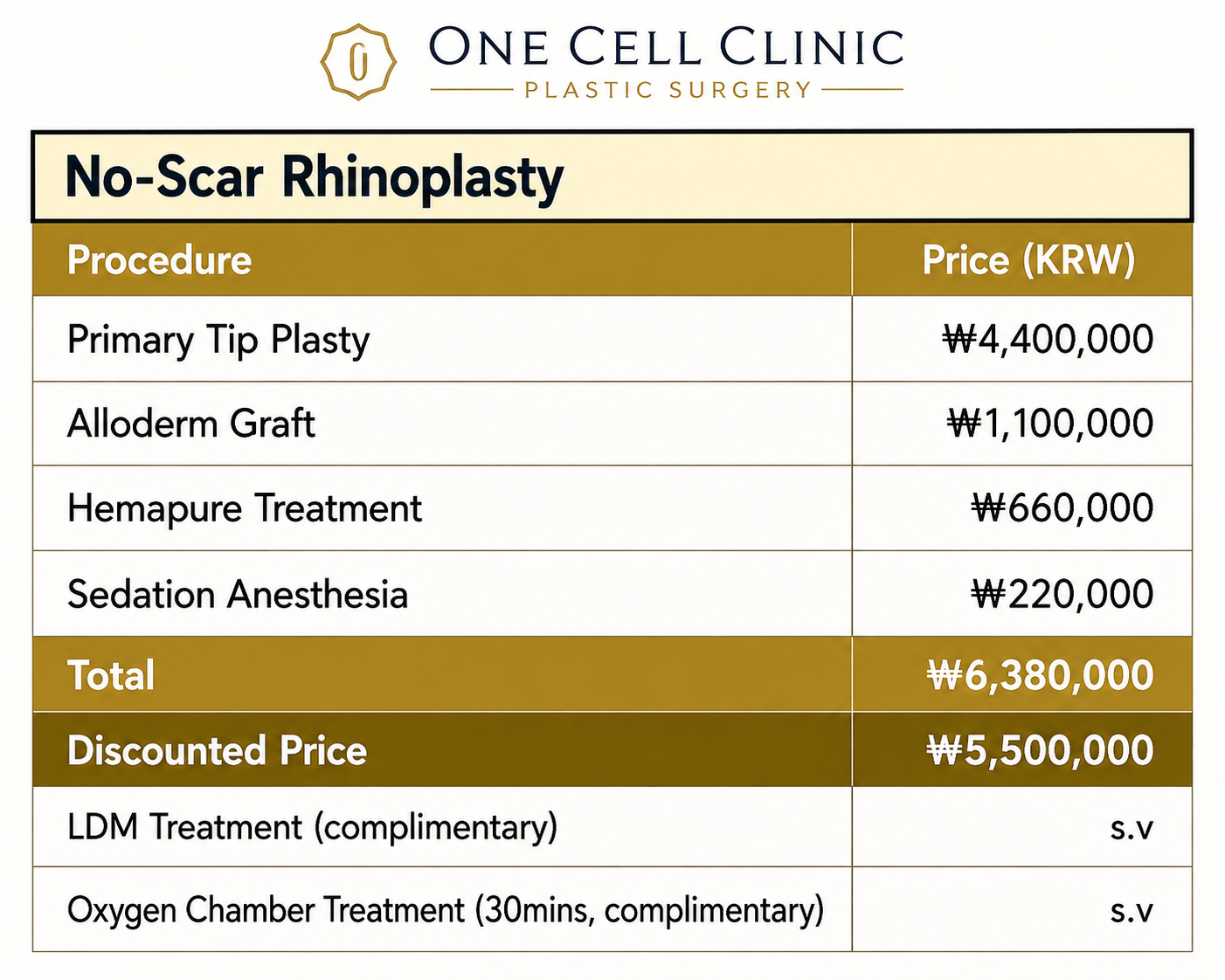
Closed rhinoplasty (also called endonasal rhinoplasty) is performed with all incisions made inside the nostrils. There is no external scar.
In Korea, closed rhinoplasty is commonly chosen for patients who want subtle, natural refinement rather than major reconstruction.
Key Characteristics of Closed Rhinoplasty
- No visible external incision
- Limited surgical exposure
- Highly technique-dependent
- Faster initial recovery
- Best for primary, uncomplicated cases
What Is Open Rhinoplasty?
Open rhinoplasty involves a small incision on the columella (the tissue between the nostrils), allowing the surgeon to lift the nasal skin and see the entire nasal structure directly.
In Korea, open rhinoplasty is widely used for complex shaping, revisions, and structural reconstruction.
Key Characteristics of Open Rhinoplasty
- Small external incision (usually fades over time)
- Full visibility of nasal anatomy
- Greater precision for structural changes
- Longer swelling period
- Preferred for difficult or revision cases
Main Differences Explained Clearly
Incision & Scarring
Closed rhinoplasty leaves no visible scar because incisions are internal.
Open rhinoplasty leaves a small external scar, which usually becomes barely noticeable with proper healing.
Surgical Visibility
Closed rhinoplasty offers limited visibility, relying heavily on surgeon experience and tactile skill.
Open rhinoplasty provides direct, full visualization, allowing more precise structural modification.
Level of Correction
Closed rhinoplasty is ideal for minor to moderate changes such as bridge augmentation or slight tip refinement.
Open rhinoplasty is better for major reshaping, crooked noses, short noses, thick skin, or revision surgery.
Operating Time
Closed rhinoplasty often takes less time.
Open rhinoplasty typically takes longer due to more detailed dissection and reconstruction.
Recovery & Downtime Comparison
Closed Rhinoplasty Recovery
- Swelling and bruising usually milder
- Faster return to daily activities
- No external stitches
- Final shape visible sooner
Open Rhinoplasty Recovery
- More swelling, especially at the tip
- External stitches removed in about 5–7 days
- Longer time for final definition
- Better long-term stability for complex noses
Both methods require patience, as final results can take several months to fully settle.
Cost Differences in Korea
In Korea, closed rhinoplasty is often slightly less expensive than open rhinoplasty because:
- Shorter surgery time
- Less extensive dissection
However, cost depends more on complexity and materials than on the approach alone. A simple open rhinoplasty may cost less than a complex closed case.
Which One Looks More Natural?
Both closed and open rhinoplasty can achieve very natural results in Korea when performed by experienced surgeons.
- Closed rhinoplasty is often chosen for “no one notices” refinement
- Open rhinoplasty is preferred when structural balance and long-term shape stability are critical
The technique does not determine naturalness — surgical planning and execution do.
Who Is a Good Candidate for Closed Rhinoplasty?
Closed rhinoplasty is best for patients who:
- Are undergoing first-time rhinoplasty
- Want subtle, natural changes
- Do not need major structural correction
- Prefer no external scar
- Have relatively symmetric nasal anatomy
Who Is a Good Candidate for Open Rhinoplasty?
Open rhinoplasty is better for patients who:
- Need significant reshaping or correction
- Have a crooked, short, or drooping nose
- Have thick nasal skin
- Are revision rhinoplasty patients
- Require complex cartilage reconstruction
Why Korean Surgeons Use Both Approaches
In Korea, experienced rhinoplasty surgeons do not choose one method exclusively. Instead, they select the approach that best fits the patient’s anatomy and goals.
Many Korean surgeons are especially skilled in closed rhinoplasty for natural Asian nose design, while also using open rhinoplasty when precision and structure are required.
Final Expert Summary
Closed and open rhinoplasty are not competing techniques — they are tools used for different situations.
Closed rhinoplasty offers:
- No visible scar
- Faster recovery
- Subtle, natural refinement
Open rhinoplasty offers:
- Maximum precision
- Structural correction
- Better outcomes for complex cases
The best approach depends on your nose, not your preference alone. A detailed consultation with an experienced rhinoplasty specialist is essential.